As Catholics, we believe that Jesus Christ is truly present in the Blessed Sacrament. Since the 11th Century, it has been customary to reserve some of the Blessed Sacrament in tabernacles in our churches and chapels. This has a twofold purpose – one, it means that the Blessed Sacrament is always available to be taken to our sick and dying and two, it means that Jesus is always physically and spiritually present in our churches. For over 900 years, Catholics have been gathering and coming privately to spend time with Jesus in prayerful adoration. Any time that we spend in prayer before the Blessed Sacrament is termed adoration – whether the Eucharist is in a monstrance on an altar, in a ciborium on an altar, or secured in the tabernacle.
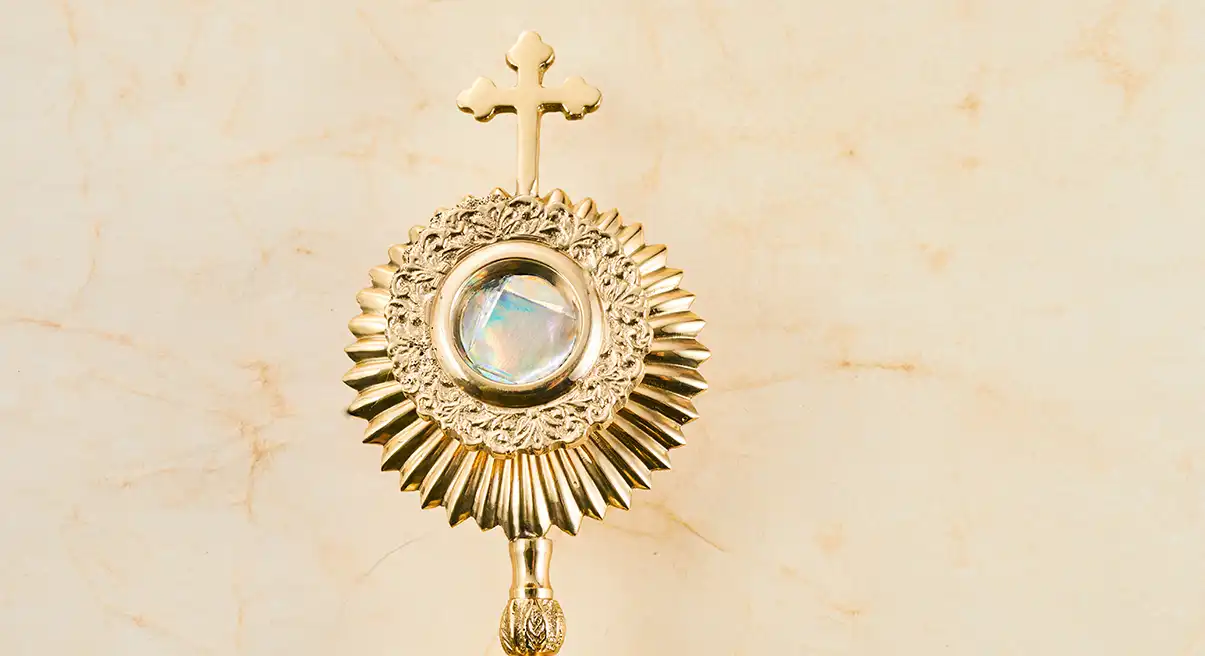
What is commonly called adoration today is accurately termed “Exposition of the Blessed Sacrament”- the act of reverently removing the Blessed Sacrament from the tabernacle and placing it in a monstrance on an altar where all the assembled faithful may view it and pray before it. Exposition is a solemn liturgical ritual of the Church and as such is governed by the liturgical norms and rituals of the Church.
The celebration of the Eucharist in the sacrifice of the Mass is “truly the origin and purpose of the worship that is shown to the Eucharist outside Mass.” Eucharistic adoration extends Holy Communion in a lasting way and prepares us to participate more fully in the celebration of the Eucharistic mystery. It leads us to “acknowledge Christ’s marvelous presence in the sacrament” and “invites us to the spiritual union with him that culminates in sacramental communion.” (USCCB, 31 Questions on Adoration)
What is Perpetual Adoration?
Perpetual Adoration is the custom of having the Blessed Sacrament accessible to the faithful for adoration around the clock, and in the case of perpetual exposition, ensuring that adorers are scheduled and present for adoration for extended periods of time and ideally 24 hours a day, 7 days a week. A parish can still be said to have perpetual adoration even adoration is temporarily paused during Sunday Masses or for a weekly cleaning period.
Holy Communion and Worship of the Eucharist outside Mass (HCWEOM), no. 90, states that, according to their constitutions and regulations, some religious communities and other pious groups have the practice of perpetual eucharistic adoration or adoration over extended periods of time. If by “perpetual eucharistic adoration” is meant prayer before the Blessed Sacrament in the tabernacle, this involves no special permission. However, if by “perpetual eucharistic adoration” is meant adoration of the Blessed Sacrament exposed in the ciborium or monstrance, the permission of the local Ordinary is required.
What is required for Perpetual Exposition?
Groups and parishes authorized to have perpetual exposition are bound to follow all the liturgical norms given in Holy Communion and Worship of the Eucharist outside Mass, nos. 82-100. Under no circumstances may perpetual exposition take place during the Easter Triduum. There should always be a sufficient number of people present for eucharistic adoration before the Blessed Sacrament exposed (see HCWEOM, no. 88). Every effort should be made to ensure that there should be at least two people present. There must absolutely never be periods when the Blessed Sacrament is exposed and there is no one present for adoration. It may prove necessary to expose the Blessed Sacrament for adoration only at stated times when members of the faithful are present.
How should the Blessed Sacrament be displayed during Exposition?
The Blessed Sacrament should be placed in a place of reverence (generally an altar) either in a monstrance or in a ciborium. Exposition does not necessarily imply the Blessed Sacrament itself is visible, merely that it is not reposed in the tabernacle. When the Blessed Sacrament is exposed in a ciborium, 2 or more candles may be lit; when exposed in a monstrance, 6 candles should be lit. Placing the monstrance on an elevated surface such as a thabor is a praiseworthy practice that both communicates the holiness and specialness of the Eucharist in the monstrance, but also frequently makes the Host more visible to those assembled. The monstrance, or the thabor, should sit on a clean corporal a top a white altar cloth.
Who may expose and repose the Blessed Sacrament?
A priest or deacon may do solemn Exposition and Benediction of the Blessed Sacrament. A lay person trained as an Extraordinary Minister of Holy Communion may be delegated by the pastor to do a simple exposition and reposition of the Blessed Sacrament after a set time of adoration when an ordinary minister (priest/deacon) is “lawfully impeded” from exposing and reposing. This is not a blanket permission for all adorers or even all EMHCs from exposing and reposing of their own volition or at unappointed times. [Examples: The pastor, Fr. John, can ask parish employee and EMHC Joseph to expose and repose the Blessed Sacrament for the 3rd Graders at 2pm on Friday afternoon or EMHC Mary to expose and repose the Blessed Sacrament for the monthly holy hour for vocations at 5pm on first Monday of the month. ].
Can adorers repose the Blessed Sacrament if no one is adoring after them?
This should not happen. Exposition presupposes that a number of the faithful are gathered to adore the exposed Blessed Sacrament. There should always be at least two people present when the Blessed Sacrament is exposed and parishes should refrain from having more hours of Exposition than they can guarantee adorers for. Parishes should have a plan for if this situation arises and all adorers should be trained in the protocols for this happening, but this situation should be a rare emergency and not a regular occurrence. The ideal would be for the adorer to remain in place until the next arrives, or to have a member of the clergy to call to repose the Blessed Sacrament for the rest of the day or night.
Order of Solemn Exposition of the Blessed Sacrament #13: Where there cannot be uninterrupted exposition because there is not a sufficient number of worshipers, it is permissible to replace the blessed sacrament in the tabernacle at fixed hours that are announced ahead of time. But this may not be done more than twice during a day for example, at midday and at night.
Can we use a tabernacle with a door in it to expose the Blessed Sacrament?
No. This is contrary to the nature and norms for Perpetual Exposition in several respects:
- Modern norms on Exposition presuppose the removal of the Eucharist from the tabernacle for communal worship.
- Exposition is a solemn liturgical ceremony of the Church. All instances of Exposition of the Blessed Sacrament are governed by the Order of Solemn Exposition or Holy Communion and the Worship of the Eucharist Outside of Mass. It is not an act of private or personal devotion or reverence. Just as we do not walk into the church and demand a private Mass whenever we want, we don’t walk into the sanctuary and expose the Blessed Sacrament on our own terms.
- It encourages people to enter the sanctuary and play with the tabernacle.
- It perpetuates the notion that Jesus is more present if the Host is visible than if it is merely present in the tabernacle. In reality, Jesus is fully present in all of our churches all of the time.
No Diocese of Phoenix church should be purchasing or using tabernacles with “Peek-a-boo Jesus” windows.