
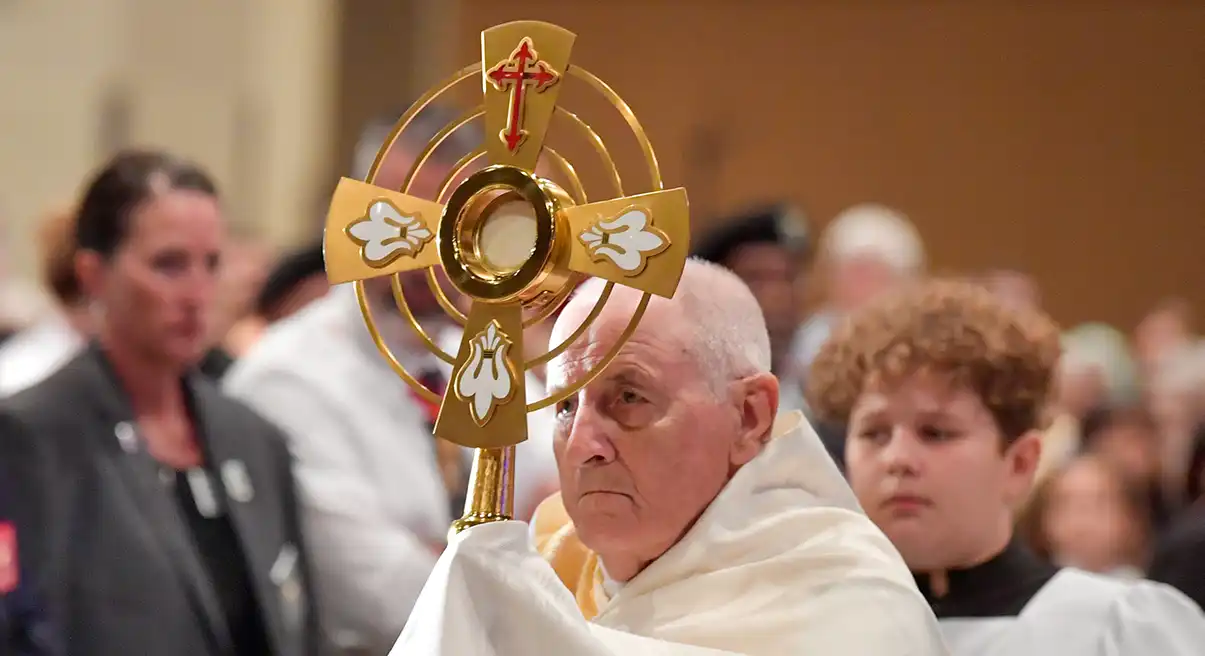
In the celebration of the Eucharist, bread and wine become the Body and Blood of Jesus Christ through the power of the Holy Spirit and the instrumentality of the priest. The whole Christ is truly present — body, blood, soul, and divinity — under the appearances of bread and wine, the glorified Christ who rose from the dead. This is what the Church means when she speaks of the “Real Presence” of Christ in the Eucharist.
Bible references of the Eucharist
Readings on the Nature of the Eucharist
Included here are some books and resources that may assist your meditation on the Holy Eucharist:
- Catechism of the Catholic Church – The Sacrament of the Eucharist (Section 2, Article 3)
- Eucharistic Meditations – St. John Vianney
- How to Get More Out of Holy Communion – St. Peter Julian Eymard
- God is Near Us: The Eucharist, the Heart of Life – Cardinal Joseph Ratzinger (Pope Benedict XVI)
- Ecclesia de Eucharistia (On the Eucharist) – St. Pope John Paul II
- Sacramentum Caritatis: Post Synodal Exhortation on the Eucharist – Pope Benedict XVI
- Five Loaves and Two Fish: Meditations on the Eucharist – Cardinal Francis Xavier Nguyen van Thuan
- The Source of Life: Exploring the Mystery of the Eucharist – Cardinal Christoph Schonborn
- The Holy Eucharist – Cardinal Francis Arinze
- The Eucharist: Our Sanctification – Fr. Raniero Cantalamessa, OFM Cap.
- Eucharistic Miracles of the World (Catalogue of the Vatican International Exhibition) – Cardinal Raymond Leo Burke
- Divine Love Made Flesh: The Holy Eucharist as the Sacrament of Charity – Cardinal Raymond Leo Burke
- Consuming the Word: The New Testament and the Eucharist in the Early Church – Scott Hahn
- A Biblical Walk Through the Mass – Edward Sri
Online Reading
- The Real Presence of Jesus Christ in the Sacrament of the Eucharist: Basic Questions and Answers (USCCB)
- US Catholic Catechism for Adults – The Eucharist: Source and Summit of the Christian Life
Eucharistic Hymns
The Diocese of Rapid City produced a book of Eucharistic hymn-based lessons for youth as part of their 2019-2020 Year of the Eucharist. Click to view.
Traditional
- Adoro Te Devote PDF
- At the Lamb’s High Feast PDF
- Ave Verum Corpus PDF
- Ave Vivens Hostia
- Father, We Thank Thee Who Has Planted PDF
- In This Sacrament, Sweet Jesus PDF
- Jesus, my Lord, my God, my all! PDF
- Lauda Sion Salvatorem
- Let All Mortal Flesh Keep Silence PDF
- Lord Who At They First Eucharist PDF
- Now, My Tongue, the Mystery Telling PDF
- O Food to Pilgrims Given (O Esca Viatorum) PDF
Contemporary
- I am the Bread of Life
- One Bread, One Body
- Take and Eat
- Pan de Vida
The Holy Eucharist in Mass
Suitable Wines for the Blessed Sacrament
GIRM 322. The wine for the celebration of the Eucharist must be from the fruit of the vine (cf. Lk 22:18), natural, and unadulterated, that is, without admixture of extraneous substances.
Code of Canon Law 924 §3. The wine must be natural from the fruit of the vine and not spoiled.
Redemptionis Sacramentum #50. The wine that is used in the most sacred celebration of the Eucharistic Sacrifice must be natural, from the fruit of the grape, pure and incorrupt, not mixed with other substances. During the celebration itself, a small quantity of water is to be mixed with it. Great care should be taken so that the wine intended for the celebration of the Eucharist is well conserved and has not soured. I t is altogether forbidden to use wine of doubtful authenticity or provenance, for the Church requires certainty regarding the conditions necessary for the validity of the sacraments. Nor are other drinks of any kind to be admitted for any reason, as they do not constitute valid matter.
Suitable wine must be the product of the natural fermentation of grapes . By definition, wine is 8-14% alcohol; once you get to 14% alcohol and above it is considered fortified wine and is not suitable for sacramental use. Otherwise, no specific % alcohol content is required.
Wine for use in the Eucharist must be made from the fermentation of grapes (including raisins), not the fermentation of other fruits or of grains. The resultant wine may be red, rose, blush, or white; but it cannot be sparkling (such as champagne). The fermentation process must be natural; that is, from the action of yeast (wild or commercial) on the grapes themselves. The addition of sugar to speed up the process or increase the alcohol content is not allowed.
Wine for use in the Eucharist must be unadulterated. Adding water to the wine in a quantity equal to or greater than that of the wine renders it invalid matter. Adding any other liquids to the wine renders it invalid if it can no longer be judged to be wine in the common estimation of persons. Likewise, the wine cannot be so sour that it would be considered vinegar rather than wine.
Flavors – Wines are allowed to pick up extra flavors from being stored in wooden casks, barrels, or new wineskins but should not have flavors added to it (i.e. a sangria or flavored wine). Those flavors come naturally as part of the aging process in making the wine. The sulfites used to preserve the wine are not considered.
A wide variety of wines are suitable as altar wines. If in doubt, stick to sacramental wines available from local church supply companies (i.e. Cribari, Mont La Salle, etc.)
Altar Breads for Consecration
For bread to be valid matter for the Eucharist, it must be made solely of wheat, contain enough gluten to effect the confection of bread, be free of foreign materials, and unaffected by any preparation or baking methods which would alter its nature. The amount of gluten necessary for validity in such bread is not determined by minimum percentage or weight, though hosts which have no gluten are considered invalid matter for Mass. (In the Roman Rite, the bread prepared for the Eucharist must also be unleavened.)
Altar breads suitable for Holy Communion are available from a variety of sources. Our office encourages the purchase of breads which support and/or are manufactured by religious communities:
Altar Breads – Santa Rita Abbey Monastic Community
The Cistercian nuns at Santa Rita Abbey in Sonoita, Arizona bake whole wheat presider and communicant hosts.
…Altar Breads BSPA – Benedictine Sisters of Perpetual Adoration
These sisters had to stop producing their wheat line during COVID after 110 years of baking but are still the best supplier of Low-Gluten hosts.
Gluten Free and Low Gluten Hosts
For bread to be valid matter for the Eucharist, it must be made solely of wheat, contain enough gluten to effect the confection of bread, be free of foreign materials, and unaffected by any preparation or baking methods which would alter its nature. The “Gluten Free” hosts available from Cavanagh are not suitable for the Eucharist.
If an individual has a severe case of celiac disease and is not able to receive even the smallest amount of gluten, they are invited to receive the Precious Blood alone, knowing that they have received the fullness of the Body and Blood of Christ, truly present in the Precious Blood. A special chalice may be set aside for those at risk from cross contamination.
USCCB article on Celiac Disease and Alcohol Intolerance
Suitable low-gluten hosts are available from:
- Benedictine Sisters of Perpetual Adoration
Altar Breads Department
31970 State Highway P
Clyde, MO 64432-8100
Phone: (800) 223-2772
Web: www.BenedictineSisters.org - Parish Crossroads
P.O. Box 2413
Kokomo, IN 46904
Phone: (800) 510-8842
Web: www.ParishCrossroads.com - GlutenFreeHosts.com Inc.
100 Buckley Road
Liverpool, NY 13088
Phone: (800) 668-7324 ext. 1
Web: www.GlutenFreeHosts.com - Cavanagh Company
610 Putnam Pike
Greenville, RI 02828
Phone: (800) 635-0568
Web: www.CavanaghCo.com
Norms for Communion under Both Kinds
From the USCCB Website:
(Text can also be found in the front of the 2011 Roman Missal)
Diocese of Phoenix 2011 Norms for the Distribution of Holy Communion Under Both Kinds
Guide for Extraordinary Ministers of Holy Communion (EMHC)
Diocesan Policies – The Diocesan Policy for EMHCs is available here.
Please know that this policy was last revised in 2006 and does not reflect current practice. In particular, #4 has not been a practice of the Office of Worship for at least the last 8-10 years. EMHCs are trained and commissioned by the parish / pastor solely for service in that parish and the Office of Worship does not currently track or monitor EMHCs in the parishes. All parishes will be notified if a revised policy is promulgated.
General Principles
In every celebration of the Eucharist, there should be a sufficient number of ministers of Holy Communion so that it may be distributed in a reverent and orderly manner. Bishops, priests and deacons distribute Holy Communion in virtue of their office as ordinary ministers of the Body and Blood of the Lord. (1) When the size of the congregation or the incapacity of the bishop, priest, or deacon requires it, the celebrant may be assisted by other bishops, priests, or deacons. If such ordinary ministers of Holy Communion are not present, “the priest may call upon extraordinary ministers to assist him, i.e., duly instituted acolytes or even other faithful who have been deputed for this purpose. In case of necessity, the priest may also depute suitable faithful for this single occasion (GIRM 162).”
Extraordinary Ministers of Holy Communion should receive sufficient spiritual, theological, and practical preparation to fulfill their role with knowledge and reverence. In all matters they should follow the guidance of the diocesan bishop ( Norms for the Distribution and Reception of Holy Communion Under Both Kinds for the Dioceses of the United States of America, NDRHC, no. 28). When recourse is had to Extraordinary Minister of Holy Communion, especially in the distribution of Holy Communion under both kinds, their number should not be increased beyond what is required for the orderly and reverent distribution of the Body and Blood of the Lord. In all matters such Extraordinary Ministers of Holy Communion should follow the guidance of the diocesan bishop (IBID).
All ministers of Holy Communion should show the greatest reverence for the Most Holy Eucharist by their demeanor, their attire, and the manner in which they handle the consecrated bread or wine. Should there be any mishap–as when, for example, the consecrated wine is spilled from the chalice–then the affected “area . . . should be washed and the water poured into the sacrarium [ GIRM, 280].” (NDRHC, 29).
Liturgy of the Eucharist
- As the Agnus Dei or Lamb of God is begun, the Bishop or priest alone, or with the assistance of the deacon, and if necessary of concelebrating priests, breaks the eucharistic bread. Other empty ciboria or patens are then brought to the altar is this is necessary. The deacon or priest places the consecrated bread in several ciboria or patens, if necessary, as required for the distribution of Holy Communion. If it is not possible to accomplish this distribution in a reasonable time, the celebrant may call upon the assistance of other deacons or concelebrating priests.
- If extraordinary ministers of Holy Communion are required by pastoral need, they should not approach the altar before the priest has received Communion. After the priest has concluded his own Communion, he distributes Communion to the extraordinary ministers, assisted by the deacon, and then hands the sacred vessels to them for distribution of Holy Communion to the people.
- All receive Holy Communion in the manner described by the General Instruction to the Roman Missal, whether priest concelebrants (cf. GIRM, nos. 159, 242, 243, 246), deacons (cf. GIRM, nos. 182, 244, 246), or Extraordinary Ministers of Holy Communion (cf. GIRM, no. 284). Neither deacons nor lay ministers may ever receive Holy Communion in the manner of a concelebrating priest. The practice of Extraordinary Ministers of Holy Communion waiting to receive Holy Communion until after the distribution of Holy Communion is not in accord with liturgical law. (NDRHC, 39; GIRM, 160).
- After all Extraordinary Ministers of Holy Communion have received the Eucharist, the bishop or priest celebrant reverently hands vessels containing the Body or the Blood of the Lord to the deacons or extraordinary ministers who will assist with the distribution of Holy Communion. The deacon may assist the priest in handing the vessels containing the Body and Blood of the Lord to the Extraordinary Ministers of Holy Communion. (NDRHC, 40).
- The proper and only permissible form for distributing Holy Communion is to offer the consecrated bread by saying, “The Body of Christ” and to offer the consecrated wine by saying, “The Blood of Christ.” No other words or names should be added; and the formula should not be edited in any way. (Cf. GIRM, 161; 284-287).
- If the Eucharistic bread or some particle of it falls, it should be picked up reverently by the minister. The consecrated bread may be consumed or completely dissolved in water before being poured down the sacrarium.
- Should there be any mishap, for example, if the consecrated wine is spilled from the chalice, the area should be washed and the water poured into the sacrarium.
- In those instances when there remains more consecrated wine than was necessary, if needs dictate, Extraordinary Ministers of Holy Communion may consume what remains of the Precious Blood from their cup of distribution with the permission of the diocesan bishop. The sacred vessles are to be purified by the priest, the deacon or an instituted acolyte. The amount of wine to be consecrated should be carefully measured before the celebration so that none remains afterward. It is strictly forbidden to pour the Precious Blood into the ground or into the sacrarium. (NDRHC, 51-55).
- Similarly, “consecrated hosts are to be reserved in a ciborium or vessel in sufficient quantity for the needs of the faithful; they are to be frequently renewed and the old hosts properly consumed” (Code of Canon Law, no. 939). Burying hosts or consecrated Eucharistic bread is strictly forbidden.
Notes
- Norms for the Distribution and Reception of Holy Communion Under Both Kinds for the Dioceses of the United States of America [NDRHC] (August, 2002), no. 26 and cf. GIRM no. 162 and NRHC, no. 28
2010, United States Conference of Catholic Bishops. If you have altered the materials, please include the citation: Based upon Roman Missal Formational Materials provided by the Secretariat for the Liturgy of the United States Conference of Catholic Bishops, 2010.”
Who Can Receive Communion in a Catholic Church
For Catholics
As Catholics, we fully participate in the celebration of the Eucharist when we receive Holy Communion. We are encouraged to receive Communion devoutly and frequently. In order to be properly disposed to receive Communion, participants should not be conscious of grave sin and normally should have fasted for one hour. A person who is conscious of grave sin is not to receive the Body and Blood of the Lord without prior sacramental confession except for a grave reason where there is no opportunity for confession. In this case, the person is to be mindful of the obligation to make an act of perfect contrition, including the intention of confessing as soon as possible (canon 916). A frequent reception of the Sacrament of Penance is encouraged for all.
For our fellow Christians
We welcome our fellow Christians to this celebration of the Eucharist as our brothers and sisters. We pray that our common baptism and the action of the Holy Spirit in this Eucharist will draw us closer to one another and begin to dispel the sad divisions which separate us. We pray that these will lessen and finally disappear, in keeping with Christ’s prayer for us “that they may all be one” (Jn 17:21).
Because Catholics believe that the celebration of the Eucharist is a sign of the reality of the oneness of faith, life, and worship, members of those churches with whom we are not yet fully united are ordinarily not admitted to Holy Communion. Eucharistic sharing in exceptional circumstances by other Christians requires permission according to the directives of the diocesan bishop and the provisions of canon law (canon 844 §4). Members of the Orthodox Churches, the Assyrian Church of the East, and the Polish National Catholic Church are urged to respect the discipline of their own Churches. According to Roman Catholic discipline, the Code of Canon Law does not object to the reception of Communion by Christians of these Churches (canon 844 §3).
Spiritual Communion Prayer –
All those who are not receiving Holy Communion are invited to make an offering of Spiritual Communion.
My Jesus, I believe that you are truly present in the Most Holy Sacrament. I love You above all things, and I desire to receive You in my soul. Since I cannot at this moment receive You sacramentally, come at least spiritually into my heart. I embrace You as if You were already there and unite myself wholly to You. Amen.
Purification of Vessels
The Diocesan Policy and supplemental materials on the Purification of Sacred Vessels are available here: Sacred-Vessel-Purification.pdf
Sacred Vessels may only be purified by priests, deacons, and instituted acolytes. They are not to be purified by Extraordinary Ministers of Holy Communion, parish altar servers, or sacristans.
Worship of The Blessed Sacrament
Resources for Eucharistic Processions
Eucharistic Canopy for Loan
The Office of Worship has purchased a Eucharistic canopy for loan throughout the Diocese. Contact Alyssa at ayingling@dphx.org to borrow the canopy for your parish procession.
Eucharistic Revival Resources from the Knights of Columbus:
The Knights of Columbus have put together a “How To” video for Eucharistic processions as well as Eucharistic Processions Guidebook A Spanish language Procession Guide is also available here.
Source and Summit is Offering Free Booklet Templates
Adoration and Exposition
As Catholics, we believe that Jesus Christ is truly present in the Blessed Sacrament. Since the 11th Century, it has been customary to reserve some of the Blessed Sacrament in tabernacles in our churches and chapels. This has a twofold purpose – one, it means that the Blessed Sacrament is always available to be taken to our sick and dying and two, it means that Jesus is always physically and spiritually present in our churches. For over 900 years, Catholics have been gathering and coming privately to spend time with Jesus in prayerful adoration. Any time that we spend in prayer before the Blessed Sacrament is termed adoration – whether the Eucharist is in a monstrance on an altar, in a ciborium on an altar, or secured in the tabernacle.
Books and Articles for Adoration
Reference, Rubrics and History
- Holy Communion and the Worship of the Eucharist Outside of Mass – ICEL
- Excerpts from 31 Questions on Adoration of the Blessed Sacrament *** The complete text of 31 Questions is available from the Office of Worship.
- The History of Eucharistic Adoration – EWTN
- Eucharistic Adoration After Vatican II – Edward Foley
Devotional and Prayer Resources
- Visits to the Blessed Sacrament and the Blessed Virgin Mary – St. Alphonsus Ligouri
- Manual for Eucharistic Adoration – Poor Clares of Perpetual Adoration
- The Adoration Companion – Magnificat
- Pope Francis on the Eucharist: 100 Daily Meditations for Adoration – Pope Francis
- 40 Hours: An Adoration Companion – Bishop Kevin Rhoades, Our Sunday Visitor
- In Sinu Jesu: When Heart Speaks to Heart — The Journal of a Priest at Prayer – A Benedictine Monk
- Praying for Priests – Kathleeen Beckham
Holy Hour Booklets and Services
Holy Hour in Honor of St. Paul | en español
Holy Hour for Divine Mercy Sunday
Holy Hour for Healing and Reparation for the Anniversary of Roe v. Wade
Holy Hour for Life | en español
Holy Hour for Life and Liberty
Holy Hour for Life: Extended Silent Prayer
Holy Hour for Life, Marriage, and Religious Liberty | en español
Holy Hour for Peace | en español