
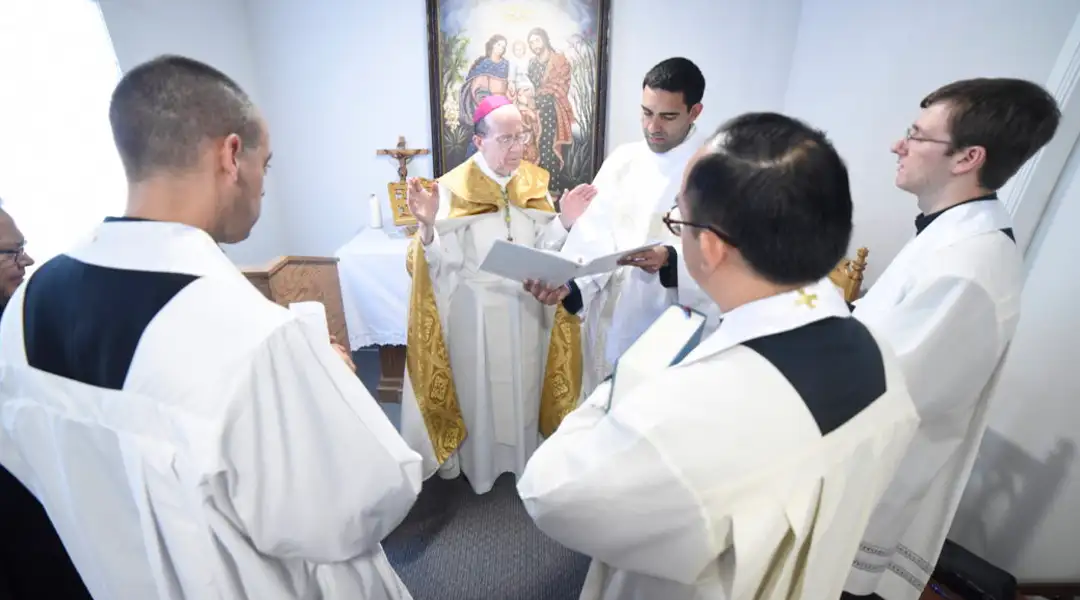
The thought of having a seminary someday in the Diocese of Phoenix was one that would come up from time to time among priests, but simply as an idea for someday. In 2002, the diocese had 18 seminarians and this number steadily increased to 42 the year that the seminary opened.
In 2016, the Church issued new guidelines for the formation of seminarians called the Ratio Fundamentalis. This document of the pontificate of Pope Francis began to address the unique realities of the formation of young men raised in the post millennial technology-saturated culture that would serve during a time when a new evangelization had called for new ardor, new methods and new expression. The document also sought to form men in the wake of unprecedented sexual abuse scandals that revealed grave errors or inadequacies in the formation of seminarians in the past generations. A few themes that arose from this document had affirmed the “household” model of seminary and an increased focus on themes of communal living and accompaniment. These changes were aimed at better meeting the needs of young men who are significantly different from the population that entered seminaries in the early 20th century when many U.S. seminaries were built. In short, seminaries built to form men of a long-past era would need to be re-configured or give way to a different model in terms of communal life and accompaniment to align with the call for a greater focus on human and spiritual formation. Our discernment as a diocese was that the larger “institutional” model of seminary would not as readily assist young men in that needed growth. A smaller household would more easily allow for the principles promoted by the Ratio Fundamentalis.
Through the Ratio Fundamentalis, the Church would begin to speak of four stages of formation. Rather than the traditional philosophy followed by theology sequence, there would be a greater focus on the seminarian as opposed to what he learned. The new stages would be as follows:
- Propaedeutic Stage (human and spiritual preparation)
- Discipleship Stage (when philosophy is studied)
- Theology/Configurative Stage (when theology is studied)
- Vocational Synthesis (after theology studies)
With this new focus, the Church wished to ensure that the seminarian would, above and beyond academics, “have reached the level of human and vocational maturity required for each stage.”
Some notable themes include the following:
Community:
“This formation has an eminently communitarian character from the outset… that should not be followed in an individualistic manner but must always have as its point of reference a specific portion of the People of God.”
Knowledge and Discernment of Service in the Diocese of Phoenix:
“Such a vocation is discovered and accepted within a community. It is formed in the Seminary, in the context of an educating community, comprised of various members of the People of God. This community leads the seminarian, through ordination, to become part of the ‘family’ of the presbyterate, at the service of a particular community.”
Overall goals:
“The pastoral care of the faithful demands that the priest have a solid formation and interior maturity. He cannot limit himself simply to demonstrating a ‘veneer of virtuous habits’, a merely external and formalistic obedience to abstract principles. Rather, he is called to act with great interior freedom.
Thus, by growing in charity, the future priest must seek to develop a balanced and mature capacity to enter into relationship with his neighbor. Indeed, he is called above all to a basic human and spiritual serenity that, by overcoming every form of self-promotion or emotional dependency, allows him to be a man of communion, of mission and of dialogue. In contemplating the Lord, who offered His life for others, he will be able to give himself generously and with self-sacrifice for God’s people.”
Founding
The idea to form our own seminary was brought to Bishop Thomas Olmsted informally in the fall of 2018. His initial thought was that another seminary was not needed and that such a task did not warrant being made a priority at this time. Subsequently, Pope Francis asked the Bishops of the United States to, in the wake of the revelation of scandals involving priests and members of the hierarchy, gather for a silent retreat. Prior to leaving for that retreat, Bishop Olmsted thought that two things would be needed if he were to consider a seminary. First, he would need clarity about a place and second, he would need a sign.
Upon returning from that retreat, he was met with a letter from a faithful parishioner who shared with him their experience of having known seminarians over the years as well as seeing the challenges that come with poor formation, including those that lead to grave damage to the Church. This person, in response to what they discerned was from the Holy Spirit, gave a check to Bishop Olmsted as seed money for a new seminary. In addition, upon returning to his office, he received news from Fr. Fred Adamson that St. Gregory Parish had a building that could be used for such a project. These served as the place and the sign that would convince Bishop Olmsted that the project could begin.
The Name
The Nazareth House (Later changed to Nazareth Seminary) was so named by Bishop Olmsted to recall that Our Lord lived His life prior to His public ministry in a home and under the care of Mary and Joseph in the community of Nazareth. As the Catechism states, the home is the first school of Christian life and the school of human enrichment where one learns endurance, the joy of work, fraternal love, generosity, forgiveness and worship in prayer and offerings of life (CCC 1657). In our own community, Phoenix, our seminarians share a home where they are able to grow in these same ways. This creates bonds with our diocese and with one another that will greatly bless them and our local church.